The day a model launch stopped being just a model launch
Yesterday, DeepSeek dropped V4 Pro, and the most interesting part wasn’t the model. That’s a strange sentence to write, because on paper the model is genuinely impressive: a Mixture-of-Experts behemoth with 1.6 trillion total parameters, 49 billion active, and a context window of one million tokens. MIT license. Weights on Hugging Face, GGUF quantizations on the way, a technical report on arXiv.
But I’ve watched enough of these launches now to know that a model card is the least interesting artifact a lab can ship. What caught my eye was the third item in the release: DeepSeek Harness, an open-source agent runtime where, in their words, “everything is a plugin.”
Open weights without a runtime are a body without a nervous system. You can read the DNA, sure, but you can’t make it do anything without building the thing around it. DeepSeek just shipped both. And I think that’s a bigger strategic signal than any benchmark table.
The model, briefly, because it deserves a minute
Let me not bury the lede too far. The specs, for the record:
- DeepSeek-V4-Pro: 1.6T total parameters, 49B activated, MoE. DeepSeek-V4-Flash: 284B total, 13B activated. Both claim a one-million-token context.
- Hybrid attention combining two forms of compression — Compressed Sparse Attention (CSA) and Heavily Compressed Attention (HCA). The punchline: at a million tokens, V4 Pro needs roughly 27% of the single-token inference FLOPs and 10% of the KV cache compared to V3.2.
- mHC (manifold-constrained hyper-connections) to strengthen residual connections, and the Muon optimizer for training stability.
- Pre-trained on 32 trillion tokens, then a two-stage post-training: cultivate domain experts independently (SFT + GRPO reinforcement learning), then consolidate them via on-policy distillation into one model.
- FP4 + FP8 mixed precision — the MoE expert parameters live in FP4, most everything else in FP8. That’s how you fit a 1.6T model on hardware that a hobbyist can actually touch.
The million-token context deserves a moment of honesty, because I’ve been burned by “long context” marketing before. There’s a huge difference between accepting a million tokens and being useful over a million tokens. The reason V4 Pro’s claim interests me more than the usual fare is the FLOPs and KV cache numbers — they’re admitting, openly, that the whole point of the architecture is to make a million tokens cheap enough to actually run, not just theoretically addressable. Most vendors brag about the context size. DeepSeek bragged about the cost at that context size. That’s the difference between a benchmark and an engineering decision.
The elephant in the room: open weights became the baseline
Here’s what I find genuinely strange about this launch, and it’s not about DeepSeek at all. A few years ago, releasing a frontier-ish model under MIT would have been an earthquake. Now it’s… Tuesday. r/LocalLLaMA nodded, quantized it, and moved on to arguing about the harness.
That’s the point. Open weights won. The question “should the frontier be open?” got answered, not by any regulator or think-tank, but by market gravity — the open models got good enough that closing them stopped being a moat worth the PR cost. DeepSeek didn’t just open-source V4 Pro; they made it boring. That’s what victory looks like from the inside.
But it reframes the competition. When everyone can download the weights, the differentiation moves up the stack. It moves to the thing you do with the model. Which is exactly why shipping a harness matters.
The harness: everything is a plugin
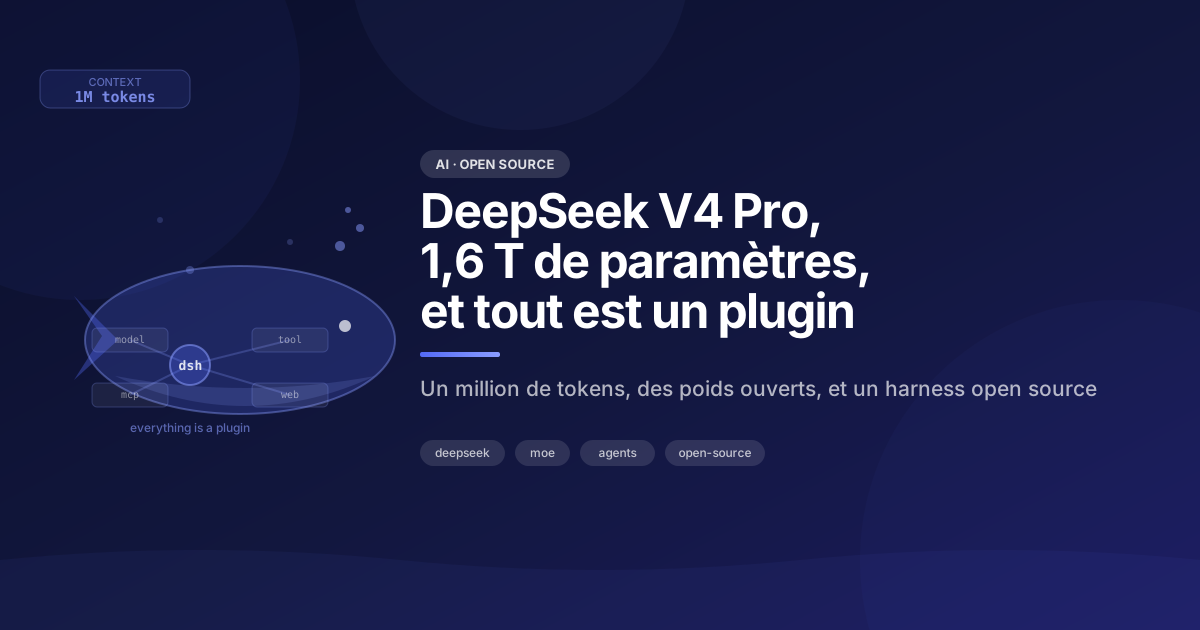
DeepSeek Harness — dsh — is an agent runtime built on an architecture where, and I’m quoting the README, everything is a plugin. It’s powered by Cordis, whose design philosophy has the gloriously academic name “A Programming Paradigm for Spatiotemporal Composability.”
Read that phrase slowly, because it’s the whole thesis. Spatiotemporal composability means the pieces of your agent — the model, the tools, the MCP servers, the web hooks, the memory — don’t live in a fixed hierarchy. They’re plugins that compose in both space (what’s wired to what) and time (what fires before what, what waits for what). You don’t bolt a tool onto a framework; you compose the agent the way you’d compose a Unix pipeline, except the “commands” are entire capabilities that can be reordered and re-nested.
The architecture has consequences that are immediately visible in the repo. It’s TypeScript and pnpm, not Python. It’s a pnpm monorepo with apps, packages, native, vendor, website — this is a serious software project, not a research artifact with a run.py stapled to it. There’s a plugin topic on GitHub (dsh-plugin) so third parties can register their plugins for discoverability. There’s a Discord. The thing is designed to be extended by strangers.
Now, the honest part: it’s in developer preview, and the README shouts it in caps — THERE WILL BE COMPATIBILITY-BREAKING CHANGES. It’s a moving target. Don’t build production on it this month. But that’s not a bug, it’s a statement of intent. They’re moving fast because they think the ground is unclaimed.
Why “everything is a plugin” is the right bet
I’ve spent enough time staring at agent frameworks — LangChain’s sprawling abstractions, the “agent harness” reimplementations that pop up weekly — to have a strong opinion here. Most of them fail the same way: they assume a shape for agents. A chain. A graph. A supervisor with sub-agents. Then reality shows up with a use case that doesn’t fit the shape, and the framework fights you.
The plugin model makes the opposite bet. It assumes nothing about the shape of your agent, because the shape is whatever you compose. The framework’s only job is to provide the substrate — lifecycle, dependency injection, event routing — and get out of the way. It’s the difference between a Lego set with instructions and a Lego set with bricks.
There’s a reason this idea keeps winning. The web beat native apps on the same logic: extensibility through a common substrate. Linux beat proprietary Unix on the same logic: a kernel plus an ecosystem of interchangeable parts. Every platform that outlived its competitors did it by making itself composable by people who’d never talk to the maintainers. DeepSeek is betting that the agent stack is the next thing to be consumed by that force.
And yes, there’s a delicious irony in the timing. The model is a 1.6T MoE that requires absurd compute to train, and the harness is a TypeScript project you can clone and run with pnpm install. The frontier model is the factory; the harness is the market.
The strategic read: commoditizing the complement
I’ll state the uncomfortable part. When a lab with DeepSeek’s funding model ships open weights and an open harness, it’s not pure altruism — it’s the classic strategy of commoditizing your complement. If the value of AI moves up the stack (into agents, tools, workflows), then the company that controls the substrate everyone builds on — and gives it away — positions itself at the center of the ecosystem without needing to win the app layer.
Google did this with Android. The browser vendors did it with the open web. DeepSeek, whatever else it is, is a state-adjacent lab with effectively unlimited cheap compute and a mandate to make AI a public good. The open harness is the natural extension: if you believe open weights should exist, you should believe open agents should exist too, because the weights are just the engine.
I’m not here to moralize about it. I’m here to note that the technical decision — “everything is a plugin” — and the strategic decision — “give the runtime away” — are the same decision. That’s rare. Usually you get one without the other.
What I’d watch (and what I’m skeptical about)
Two things to watch, two things I doubt.
Watch the plugin ecosystem. The whole bet lives or dies on whether strangers actually build dsh-plugin packages. A harness without plugins is a body with no organs. If DeepSeek can attract the MCP-tool crowd and the local-LLM tinkerers — the people who are already building glue between models and tools — this becomes the default substrate fast. If they can’t, it’s another well-architected ghost town.
Watch the precision story. FP4 experts are the reason this runs locally at all, but FP4 is where quantized models historically start to drift — hallucination rate goes up, instruction following degrades at the margins. The claim that the experts tolerate FP4 is a real research claim, not a marketing line. I want to see it survive adversarial evaluation, not just the leaderboard.
Skeptical about the million-token hype — as I said, useful-over-a-million is a different bar than accepts-a-million. The architecture numbers are encouraging. Show me a real agent doing real work across a codebase and its docs and a month of history without losing the thread, and I’ll believe the claim. Until then it’s a very promising maybe.
Skeptical about developer preview — not a criticism, just a boundary. Breaking changes in an agent framework mean breaking changes to everyone’s agents. The early adopters will pay that tax. Fine for hackers like me; fine for a lab that can afford to iterate in public.
The honest takeaway
I keep coming back to the same thought. The most interesting thing DeepSeek shipped yesterday isn’t a model with 1.6T parameters. It’s the quiet assumption baked into the release: that models are now a commodity you hand out, and the real work is the layer above them.
Five years ago the open question was “can open weights compete?” Today it’s not even a question. The new question is: who owns the layer where models become agents? DeepSeek just threw a TypeScript repo into the middle of that fight and said, “this is free, it’s MIT, and everything is a plugin.”
I don’t know if dsh wins. I know I’m cloning it tonight. And I know that whichever lab figures out the plugin substrate first — open or closed — is the one that defines how we build agents for the next five years. The weights were the easy part. Making the thing composable is the game now.