Two stories broke this week that are secretly one story
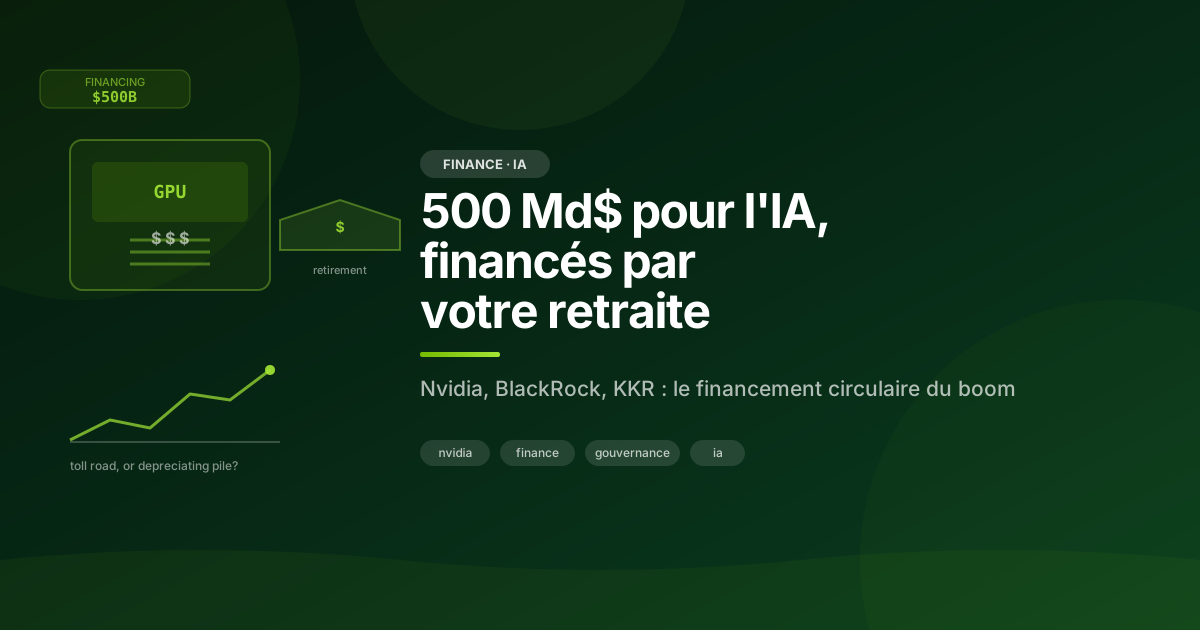
The first: Nvidia announced partnerships with Apollo, BlackRock, Blackstone, Brookfield, Goldman Sachs and KKR to build financing platforms meant to mobilize more than $500 billion for AI infrastructure. The money would come largely from “third-party investors” — read: pension funds, insurance companies, and the retirement savings of ordinary people — so that Nvidia’s customers can finance chips and data centers while Nvidia keeps its own risk off its balance sheet.
The second: a Forbes poll found that young Americans don’t trust the billionaire leaders of AI — the Musks, the Zuckerbergs, the Altmans — and, in a detail that got less play, that almost half of Americans aged 18-34 now hold at least somewhat favorable views of socialism. The r/technology thread on that poll racked up something like 24,000 upvotes before I stopped counting.
The media covered these as separate items. Finance section got the deal. Culture section got the poll. But they’re the same story, and the fact that they ran in different sections is exactly the problem. The AI boom is about to be financed by the retirement savings of the very people who don’t trust the people running it — and neither group seems to have noticed the other.
The deal, and what “circular financing” actually means
Let me be precise about the mechanics, because the word “financing” is doing a lot of quiet work here.
Nvidia makes the chips. Its customers — the hyperscalers and the AI startups and the nation-states building data centers — need enormous amounts of capital to buy them. Historically that capital came from equity or from Nvidia’s own balance sheet. But there’s a limit to how much risk Nvidia wants to carry, and the numbers have gotten big enough to spook the credit markets.
So the move is this: Nvidia partners with the private-capital firms to create financing platforms where third-party money — retirement money, insurance float, sovereign wealth — gets channeled into AI infrastructure. The customer borrows against the data center to pay Nvidia for the chips. The chips collateralize the loan. Nvidia books the sale, keeps the risk off its books, and the pension funds collect a yield on what is, in theory, a stable cash-flowing asset.
The word that keeps coming up in the coverage is circular. Fortune called it that. Bloomberg ran a piece about the deal “calming credit markets” that had grown nervous about the circularity of AI financing. Mark Cuban has been out there warning that Nvidia is effectively “funding everyone” — meaning the customers pay Nvidia with money Nvidia helped arrange for them.
Here’s the circularity in one sentence: the money to buy the chips is borrowed against the future revenue the chips are supposed to generate, and the collateral for the loan is the chips themselves. It works beautifully in a boom. It’s the AI equivalent of borrowing against your house to pay for the renovation that you hope will raise the value of the house. As long as the asset appreciates, everyone’s a genius.
The toll-road reframe, and why it’s actually clever
I want to give the deal its due, because there’s a genuinely smart idea buried in it.
The bulls’ argument is that AI compute should be treated like infrastructure — a toll road, a power plant, a cell tower. Those assets don’t have to be the best at anything; they just have to produce predictable cash flows, which makes them ideal candidates for debt financing. Pension funds love infrastructure. It’s long-duration, it’s boring, it pays steadily, and it matches their liabilities. If you can reframe a GPU cluster as a toll road, you can suddenly tap the single largest pool of patient capital on earth.
That’s not crazy. A data center with contracted tenants does look a lot like a power plant with a power-purchase agreement. The question that matters is whether the analogy holds under stress. A toll road keeps collecting tolls in a recession because people still drive. A GPU cluster only produces cash flow if someone still wants to rent GPU time next year at a price that covers the debt. And the bears’ counter-argument is exactly this: chips are not infrastructure. They’re a rapidly depreciating pile of silicon that’s obsolete in three years.
A toll road lasts fifty years. An H100 cluster is worth a fraction of its purchase price within three, because the next generation arrives and the frontier moves. If you finance a depreciating asset with 30-year pension money, you’re not building a toll road — you’re building a toll road on a road that melts.
I don’t know which side is right. I know that the answer determines whether this is the most sophisticated infrastructure play of the decade or the largest wealth transfer from retirees to chip companies in history. And I know the people making the call are the same people who will personally profit either way.
Your retirement is now long the AI boom, whether you like it or not
Here’s the part that should make you sit up. Whatever your opinion of AI — whether you think it’s the next electricity or a bubble with a marketing budget — if you have a pension or a 401(k), some of your money is probably about to be allocated into AI infrastructure. You will not be asked. You will not get a vote. The fiduciary will do it because the yield looks good relative to bonds, and the risk will be modeled as “infrastructure-like.”
That’s the mechanism by which the AI boom’s downside gets socialized. If the models monetize and the data centers print cash, the private-capital firms take their carry and Nvidia keeps selling chips and the upside is captured by a small group of people. If the models don’t monetize — if the toll road has no traffic — the losses don’t stay on Nvidia’s balance sheet (that was the whole point of the structure) and they don’t stay with BlackRock (they’re just the toll collector). They flow through to the pension funds. To the retirees. To you.
This is the part of the two stories that connects them, and it’s the part nobody wants to say out loud: the risk is being transferred to the people who had no say in the bet, and the people having the most visible say — the billionaire AI leaders — are precisely the people the next generation has decided not to trust.
The trust gap isn’t a vibe, it’s a rational read of the incentive structure
I’ve seen the takes on the Forbes poll, and they mostly fall into “Gen Z is naive” or “duh, obviously.” Both miss the point.
The poll isn’t evidence that young people are irrational about AI. It’s evidence that they’ve correctly identified a conflict of interest. The same people who tell you AI is the most important technology in human history are the people whose net worth is directly tied to you believing that. The same people who say “trust me, this will change the world” are the people who will be insulated from the downside if it doesn’t. Sam Altman doesn’t lose his retirement if the data centers stop penciling out. The 24-year-old whose pension fund just bought AI-infrastructure debt does.
You don’t have to be anti-capitalist to find that arrangement uncomfortable. You just have to notice that the people selling the boom are structurally incapable of being neutral about it, and that the people financing the boom have been opted in without consent. That’s not a crisis of faith in technology. That’s a reasonable person noticing that the deck is stacked.
And look, I’m a technologist. I think a lot of the AI boom is real. I use these models every day. I’m not rooting for the bubble to pop. But I’ve also watched enough cycles to know that the moment you need this much financial engineering to keep the party going — the off-balance-sheet vehicles, the circular deals, the retirement money, the “calming of credit markets” — is the moment you should start asking who’s holding the bag.
What I’d actually want to see
I’m not going to end this by pretending I have a clean policy answer, because I don’t. But there are a few things I’d want before I felt okay about any of this.
Transparency. If retirement money is flowing into AI infrastructure, the people whose money it is should be able to find that out without a forensic accountant. A one-line disclosure in a 400-page prospectus is not transparency; it’s a legal shield.
An honest depreciation model. The entire toll-road reframe hinges on a single assumption: that AI compute holds value like infrastructure and not like consumer electronics. I’d like to see the firms making that claim publish the depreciation curve they’re using. If they won’t, that tells you everything.
Skin in the game from the people steering it. Nvidia structuring the deal so its own risk stays off the balance sheet is rational — that’s what a company does. But when the sellers of the asset are also the guarantors of the financing and the creditors of the buyers, I want to know who eats it first when the toll road melts. If the answer is “the pensioners,” then this isn’t a financing innovation. It’s a game of hot potato where the music stops on the person who wasn’t even playing.
The sentence I keep coming back to
The AI boom is being financed by the retirement savings of people who don’t trust the people running the AI boom.
Read that again. It’s not a contradiction. It’s a description of a power arrangement. The trust is being extracted — quietly, through the pension system, in the background of people’s financial lives — even as it’s being withheld everywhere else. The poll measured the withholding. The deal measured the extraction. Same story, two sections of the newspaper.
The people who are bullish on AI get to be bullish with other people’s retirement money. The people who are bearish get to be bearish while their pension quietly goes long anyway. And the billionaires at the center get to keep telling us it’ll all work out, secure in the knowledge that if it doesn’t, someone else is holding the bag.
I don’t think that’s sustainable. I think that’s the kind of arrangement that eventually becomes a very loud, very political problem. And when it does, the same people who are surprised now will claim nobody could have seen it coming — despite the fact that both halves of the story were sitting on the front page this week, right next to each other, in different sections.